Take action and give thousands of people access to water too.
Chad is one of the countries in the world hit hardest by drought and lack of access to water.
The water crisis in Chad.
In villages without access to water, every day is a struggle. Children walk long distances in the scorching heat, several times a day, to fetch a few litres of water. And when the only water available is unsafe, it becomes a threat in itself: disease, infection, weakness… and sometimes death. Every day, families still suffer the devastating consequences of having no clean drinking water.
Donate to give access to water
Why Chad?
Extreme poverty, climate vulnerability and geographical isolation: UNICEF ranks Chad among the countries where children are most vulnerable to the effects of climate change, with recurring droughts. In Chad, more than one person in three still has no access to clean drinking water. Building a well there is not just about putting up infrastructure: it means meeting a vital need and saving lives.
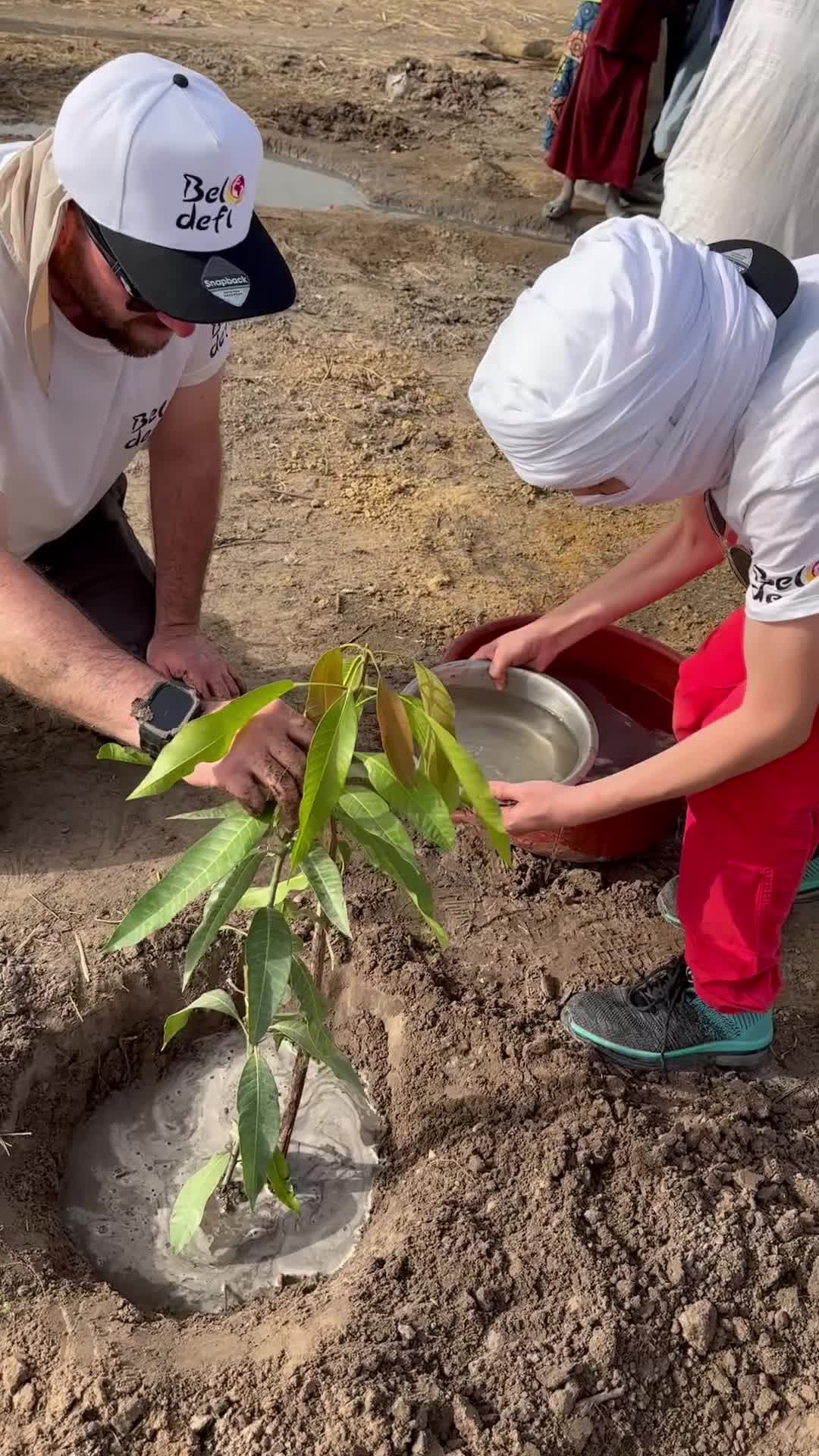
Around every well, life flourishes.
Our volunteers plant fruit trees around the boreholes. These trees will provide shade and precious fruit. The water from the well will also help develop farming in the village, a source of both food and income.

Boreholes built to the highest professional standards.
Our projects are carried out and supervised by engineers who are experts in construction and soil surveys and who specialise in drilling. We use the best, most durable materials. Our boreholes reach a depth of between 45 and 100 metres, to guarantee the purity of the water drawn. Samples are taken and water purity tests are also carried out in a laboratory.
One well transforms a whole village.
Children can finally go to school, livestock are healthier, farming develops and villagers earn an income by selling their crops.
Hand-pump well
- 45 metres deep
- Sturdy hand pump
- Clean drinking water for ± 3,000 villagers every day
- Construction supervised by our engineers
Solar-powered electric well
- 75 metres deep
- Solar panels — self-sufficient energy
- Clean drinking water for ± 15,000 villagers every day
- Built in the heart of the desert, where there is no access to water at all
Where do we work? The map of our wells.
Each dot marks one or more boreholes drilled in Chad. The circles show our expansion strategy, from our base out towards the most remote regions.
Our wells in Chad
The map is provided by OpenStreetMap. When you display it, OpenStreetMap’s servers receive your IP address.
Locations taken from our borehole records. For most wells, only the name of the village and its location are known: precise GPS coordinates, which are not always available, are being collected on the ground, and the map will be updated as we go.
Extending our impact, zone by zone.
We build wells zone by zone, reaching ever wider circles. The further out we go, the harder it becomes to reach these villages.
All our wells are carefully recorded and built to stand the test of time. Should a well ever develop a mechanical problem, our technical teams will step in directly on the ground. When you donate to a well, you can be sure you are helping to provide lasting access to water.

All about our boreholes.
Why Chad?
Firstly, Chad is one of the most drought-stricken countries in the world. Secondly, we work with a trusted team of engineers who do outstanding borehole construction work in Chad.
Who builds these wells?
Engineers who are experts in construction and soil surveys and who specialise in building boreholes. Every site is supervised from start to finish.
How long do these wells last?
Our boreholes are built to last: their depth (45 to 100 metres) and the quality of the materials guarantee lasting access to water. We also carry out repairs whenever needed.
How do we follow up on completed projects?
Our team members on the ground check the condition of the wells and the needs of the villages every week. Photos and reports are sent to donors.
How do we choose which villages to help?
Working with the local authorities and our teams on the ground, we identify the most isolated villages and those worst affected by the lack of water.
How much does it cost to drill a well?
€3,500 for a hand-pump well (45 m, ± 3,000 villagers served) and €16,000 for a solar-powered electric well (75 m, ± 15,000 villagers served). We use the best materials and the construction is supervised by engineers.
Would you like to support this project every month?
A regular donation allows us to plan new boreholes and to bring clean drinking water to the people of Chad for the long term.